
India and EU seal landmark free trade deal after two decades of stalled negotiations


Public Lokpal
January 27, 2026
India and EU seal landmark free trade deal after two decades of stalled negotiations
New Delhi : After nearly 20 years of stop-start talks, India and the European Union are finally due to seal what Commerce Minister Piyush Goyal calls the “mother of all trade deals”.
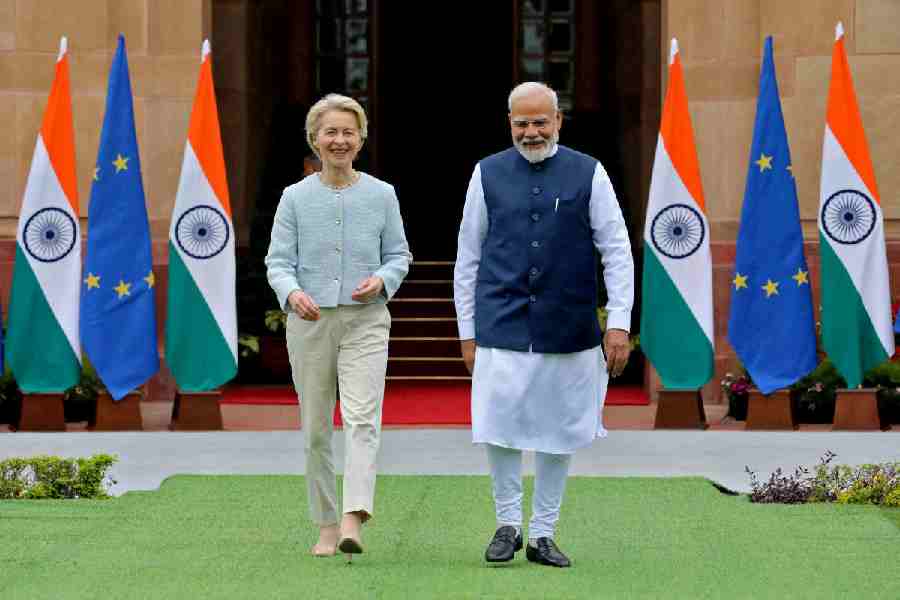
The sprawling free trade agreement (FTA) is slated to be formally announced at the India-EU summit in New Delhi today, in the presence of Prime Minister Narendra Modi and European Commission President Ursula von der Leyen, who was the chief guest at this year’s Republic Day celebrations.Together, India and the EU represent a market of nearly two billion people and close to a quarter of global GDP, making this the largest trade agreement ever concluded by either side.
Late Monday, Prime Minister Modi hailed “the growing strength of the India-European Union partnership and our commitment to shared values,” adding that the visit by top EU officials “will add momentum to the deepening engagement and cooperation between India and Europe across diverse sectors”.For India, the deal promises preferential or duty-free access for a wide swathe of exports, especially in labour-intensive sectors such as textiles, chemicals, gems and jewellery, leather, footwear and electrical machinery. At present, many of these sectors face EU tariffs of around 10 per cent, limiting their competitiveness in European markets.
For Europe, the attraction of an FTA is access to one of the world’s fastest-growing major economies, including long-sought cuts in India’s notoriously high tariffs on European goods such as cars and auto parts.
“Negotiations have been successfully concluded. The deal has been finalised. It will propel trade and investment in both economies,” Commerce Secretary Rajesh Agrawal said.
He added that the agreement is “balanced and forward-looking” and will help improve India’s economic integration with the EU.
In a significant concession, the government has agreed to immediately reduce the tax on a limited number of cars from the 27-nation bloc with an import price of more than 15,000 euros (13.5 lakh rupees), according to sources briefed on the talks cited by Reuters.
“A successful India makes the world more stable, prosperous and secure, and we all benefit,” von der Leyen said, calling her invitation to the Republic Day celebrations “the honour of a lifetime”.
European Council President Antonio Costa described the agreement as a “geopolitical stabiliser”, saying it sends a “strong and important message to the world” at a time when protectionism is rising and global trade rules are under strain.
“The EU and India believe in free trade over tariffs,” he said. “It boosts the economy, creates jobs, promotes prosperity, and provides geopolitical stability. Two of the world’s largest democracies standing up for a rules-based order — that matters.”
For India, the pact also comes at a moment when access to the US market has become markedly more difficult, with Washington imposing tariffs of 50 per cent on many key Indian exports, squeezing exporters out of the market. That has made diversification urgent, underlining why Europe is now a key destination for Indian trade.
What makes this deal especially ambitious is that it goes well beyond goods and services. The agreement is also expected to deepen cooperation in security, energy transition and climate cooperation.
Negotiations on the agreement first began in 2007, stalled in 2013, and were revived only in 2022. The main sticking points included India’s protection of its agriculture and small industries, Europe’s insistence on labour and environmental standards, and tough bargaining over cars, pharmaceuticals, wines and spirits.
The text is now undergoing what officials call “legal scrubbing”, a final technical process to iron out potential hitches.
The deal is expected to be signed later this year and could come into force in early 2027, after approval by India’s cabinet and ratification
by the European Parliament. PTI