

Delhi AQI still above 300 amid 'very poor' air quality in national capital


Public Lokpal
December 26, 2025
Delhi AQI still above 300 amid 'very poor' air quality in national capital
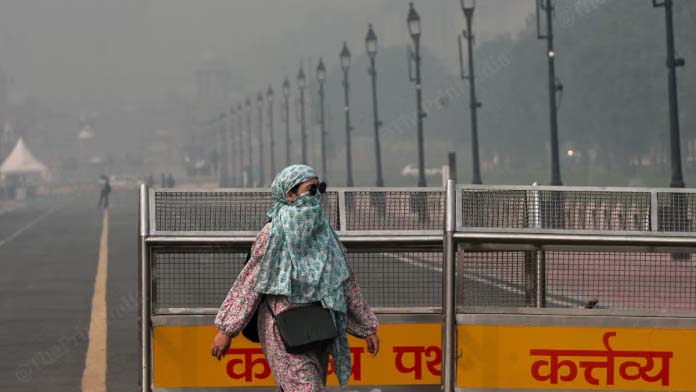
New Delhi: The national capital Delhi witnessed a significant deterioration in its air quality on Friday morning. The overall Air Quality Index (AQI) was 305 at around 8 am. Hence, entering the ‘very poor’ category, according to data from the Central Pollution Control Board (CPCB).
The air quality in Delhi was recorded at 305, following a sharp deterioration from Thursday when it was at 234. Several areas of the city were also shrouded in a thick layer of smog
Air quality deteriorated sharply compared to Thursday, when the AQI stood at 234 at 4 pm. Additionally, in today’s morning, a thick layer of smog continues to linger in parts of the city, and overall air quality remains poor.
In ITO, a thick layer of smog was present with reduced visibility, with an AQI of 330, placing it in the ‘ very poor’ category. Additionally, a thick layer of smog lingered in areas around Akshardham and AIIMS this morning.
According to CPCB data, several other areas in the capital, including Anand Vihar (390), Bawana (379), Narela (356), and R.K. Puram (320), also saw a drop in air quality, remaining in the ‘very poor’ category. Sirifort recorded similar conditions, with an AQI of 317.
However, some parts of the city fared better. NSIT Dwarka recorded an AQI of 253, placing it in the ‘poor’ category. Sri Aurobindo Marg (258), Mandir Marg (234), and IGI Airport T3 (239) also recorded relatively better air quality, but it remained in the ‘poor’ category.
According to CPCB categorisation, 0-50 is ‘good’, 51-100 ‘satisfactory’, 101-200 ‘moderate’, 201-300 ‘poor’, 301-400 ‘very poor’, and 401-500 ‘severe’.
Earlier, the Delhi Cabinet, under the leadership of Chief Minister Rekha Gupta, approved a series of major decisions to strengthen the capital’s fight against pollution and improve environmental governance.
The Cabinet approved an allocation of Rs. 100 crore for rejuvenating water bodies that are under the Delhi government. There are approximately 1,000 such water bodies in Delhi, of which 160 fall under the Delhi Government’s jurisdiction.
Sirsa stated, “The rejuvenation of Delhi’s water bodies will play a crucial role in pollution control. The Chief Minister has directed that every possible financial support be extended to complete this work within the year.”
The Cabinet also approved the establishment of Delhi’s first E-Waste Park at Holambi Kalan, covering 11.5 acres, which will adhere to the best pollution norms and operate on a 100% circular, zero-waste model.“This will be India’s first state-of-the-art e-waste facility built on zero pollution and zero wastage principles. The plant will fully recycle and reuse water through an advanced recirculation mechanism,” Sirsa said.
He emphasised that the plant will set a benchmark for sustainable e-waste management, ensuring no water or air pollution and contributing significantly to Delhi’s clean industrial infrastructure.
Additionally, the Delhi Government has decided to continue the ‘No PUCC, No Fuel’ campaign even after GRAP restrictions are lifted, reinforcing vehicle emission compliance year-round.
Announcing the outcomes, Minister for Environment Manjinder Singh Sirsa said that these initiatives would bring “a decisive reduction in sources of air and water pollution, while creating a cleaner, more sustainable urban environment.” (ANI)